Jajim can be considered another type of Kilim. The distinctive feature of Jajim lies in the increased warp threads and the variability of their colors. Jajim is essentially a type of Kilim that incorporates additional warp threads in its weaving process, serving both as a structure and aiding in creating patterns and designs, much like weft threads.
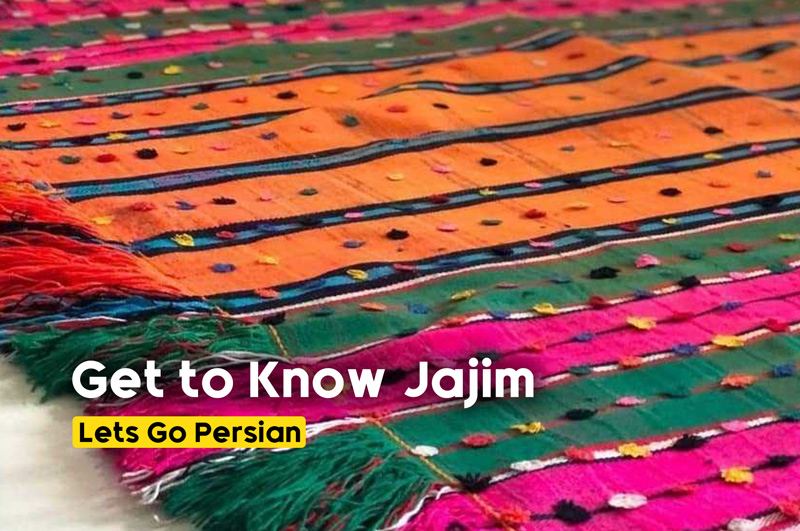
In contrast to Kilim, where both sides exhibit the same weft pattern, and no warp threads are visible, Jajim is a handwoven textile with visible warp threads on both sides, contributing to its role as a pattern creator. Due to the use of colorful warp threads and pattern creation, the design approach for Jajim differs from that of Kilim. The direction of the warp threads guides the pattern, making it non-reversible, with motifs often aligned vertically.
The unique feature of Jajim lies in its pieced weaving, as most Jajims, especially those used as horse blankets, are woven in two equal and parallel pieces, which are then stitched and paired. While most Qashqai tribe rugs are made in two parts, finely woven Jajims may have three or four legs.
Jajim comes in specific types, some of which can be used on both sides, while others are suitable for only one side. This is due to the extra warp threads, visible on both sides of the double-faced Jajim but freely drawn between two motifs on the back of the fabric.
This type of Jajim is prevalent among the Shahsevan tribe but lacks popularity among other Fars tribes. It’s important to note that double-faced Jajim weaving is characteristic of the Qashqai tribe.
Jajim Shesh-e-Darmeh
In a specific style of Jajim weaving known as Shesh-e-Darmeh, both sides of the handwoven fabric are consistent, presenting one design and pattern. However, the colors of the motifs on one side may differ from those on the other. The coloration rule of Shesh-e-Darmeh is inverse. The coloration of the back of the woven piece is opposite to the front in terms of coloration. This rule also applies to the coloration of the two-faced borders of Shesh-e-Darmeh, sometimes in dark brown, dark indigo, and occasionally white. Additionally, the pattern on the wall is always different from the main border’s design.
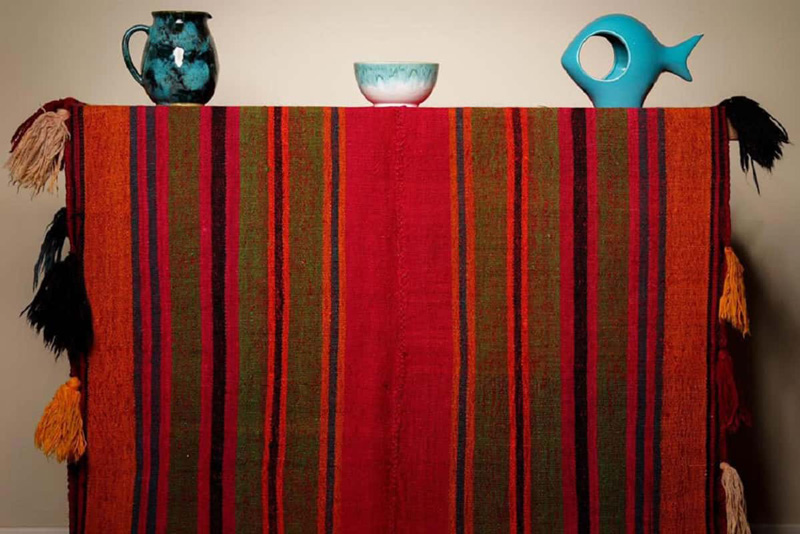
The color range in Shesh-e-Darmeh is limited since it primarily uses white and red colors. As this type of Jajim employs two layers of warp threads, the weaving is always thicker than other types using two warp and one weft threads.
In another style of Shesh-e-Darmeh, the inversion of the coloration between the uniform motifs on the back and front is maintained. However, since the back is visible and used in pattern creation, the back’s pattern lacks clarity and precision, appearing more matte and ambiguous.
The Qashqai tribe predominantly uses the Shesh-e-Darmeh technique to weave saddlecloths for large and miniature horses and camel bags. This style is rarely used for floor coverings.
To enhance the aesthetics of Shesh-e-Darmeh, silk-colored tufts are used. Most Shesh-e-Darmeh rugs belong to the Dareshuri and Shishboluki tribes.
Jajim in Fars Province is entirely made of wool, and only occasionally, silk is used for weaving white-colored sections.
Adapted from the book “Tribal Handwoven Textiles” by Master Cyrus Piroum