You’ve probably heard the words “Lachak” and “Toranj” when buying carpets. Carpets with Lachak and Toranj designs are among the best-selling patterns of Iranian carpets. But do you know what Lachak and Toranj are?
The Lachak Toranj pattern in Iranian carpets can be considered as parts of a garden located in the center of the carpet, containing one or more water basins, with four triangles surrounding the carpet. In this manner, Toranj is a typical pattern in Lachak Toranj carpets, with a central water basin surrounded by four gardens.

What is the Lachak and Toranj pattern?
Iranian carpet patterns have various categories, and the Lachak Toranj pattern holds a special place in beauty and production density. As seen in traditional and ancient maps of Iranian carpets, old Iranian gardens and their designs on carpets often featured several basins connected by water channels.
The garden or its design with regular geometric shapes such as squares, hexagons, rhombuses, and the like were clearly defined, and there was a relationship between them. The origin of this pattern can be traced back to the Golestan (Rose Garden) designs and garden patterns in Iranian carpets.
Some believe that the origin of this pattern was initially seen on the covers of Qurans and valuable books, drawing the attention of carpet designers and making its way into Iranian carpets while adhering to the principles of carpet weaving.
The Lachak and Toranj pattern is a widespread and popular design in Iranian carpets, which has been used in carpet weaving in various regions of our country since the Shah Abbasid School.
What is Lachak?
In the vocabulary of carpets, “Lachak” means a corner, and its placement is in the corners of the carpet. If Toranj accompanies these Lachaks, the pattern is called “Lachak and Toranj.”
What is Toranj?
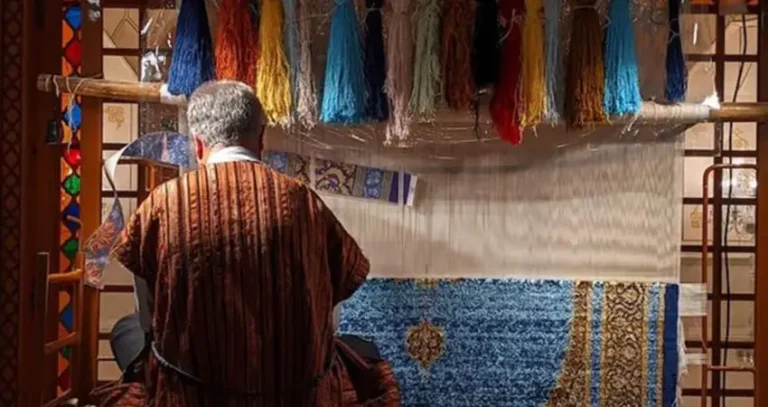
Toranj is one of the most distinctive elements used in the Lachak Toranj pattern, and its literal meaning is “Bergamot.” Toranj itself consists of various parts, with the most important factor being the central section, which is the Toranj itself. The top of the Toranj, which fills the upper and lower parts of the Toranj, is the head of the Toranj. Additionally, on the top and bottom of the middle part of the Toranj, two Toranj heads are often woven, which are referred to as “Shamseh” or “Kolaleh” by designers. Sometimes, these Kolalehs may encompass the entire perimeter of the Toranj.
Toranjs are usually designed in circular, oval, and ribbon shapes. Toranjs create a distinct space in the center of the carpet, where various Khatai and Islamic patterns (Eslimi) or other multiple designs are used inside. In reality, by using the patterns present in Toranj and the colors used, we separate the background space from the Toranj section, and Toranj stands out like a central medallion or frame in the middle of the carpet.
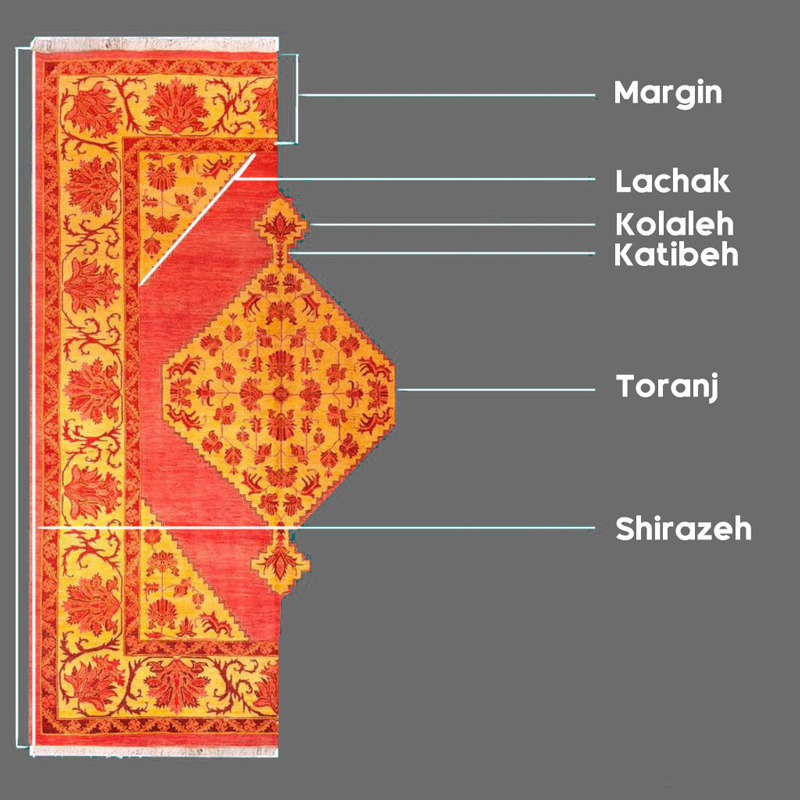
In some patterns with Toranj, instead of a single central Toranj, two or three small Toranjs along a vertical line (more in geometric shapes) are seen, and sometimes multiple Toranjs are spaced regularly throughout the carpet’s field. When several Toranjs are placed inside one another, they are called “Complicated” or Kaseh-Nim Kaseh.
The size of Toranj varies in carpets from different regions. For example, in small carpets and handwoven carpets from Isfahan, Kashan, Nain, and Abadeh, its dimensions are small, while in Tabriz, Heris, and Mashhad carpets, it is somewhat larger.