Carpet Weaving Industry in Lorestan: History and Traditions
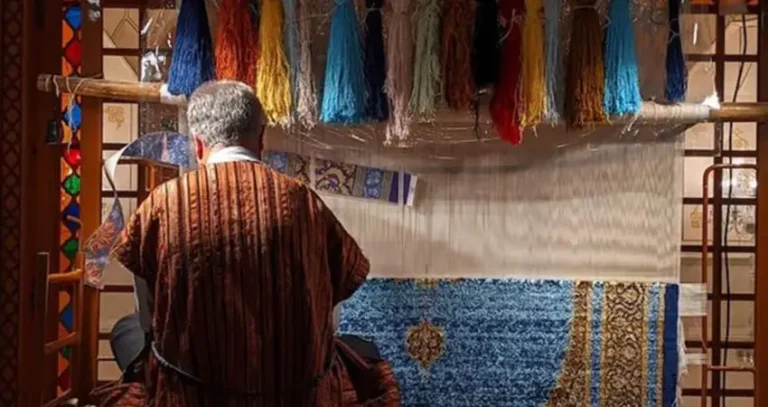
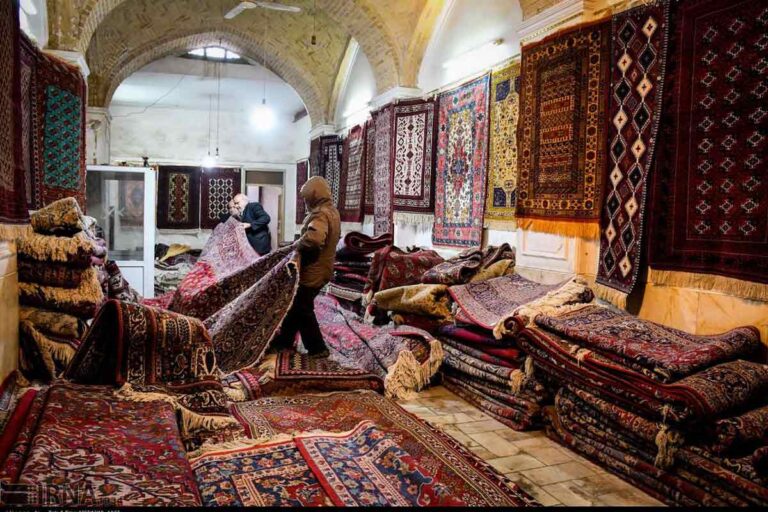
Carpet weaving is widespread in Luristan. Luristan is considered one of the leading weaving centers, with a history dating back thousands of years in Iran. Through explorations conducted in various parts of this province, evidence has been found that pushes the history of weaving in this region back to the fourth millennium BC.
For example, one of the weaving tools known as “sok,” used for making carpets, dates back to the Medes period, when all the tools were made of wood.
These pieces of evidence indicate the ancient history of Luri weaving. They can help us understand their ancient and independent traditions in weaving, raw materials, tools, and even patterns. However, no documented examples of ancient Luri’s old Carpets exist, and information is scarce.
Some historians have made general references to Luri carpets in their writings, but the oldest documented description of Luristan carpets and felt is found in a Danish traveler’s account named “Feilberg” in the book “Il Pappe: The Nomadic Tribes of Western Iran.”
In this book, he writes:
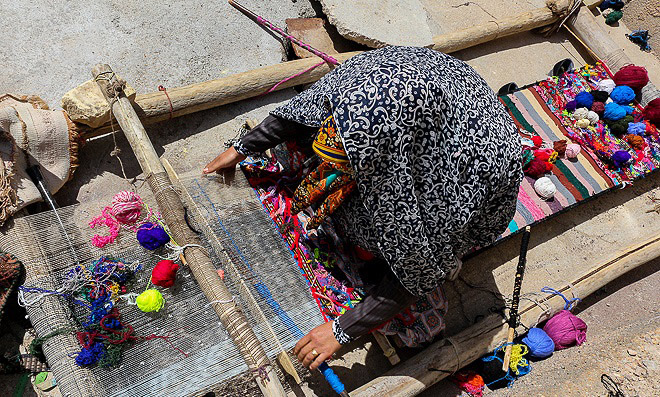
“The weaving machine I saw among the Lurs is horizontal, and all the fabrics they need for their lives can be woven on it. The length of the materials depends on the size of the threads, and these lengths are mostly not more than a few meters.
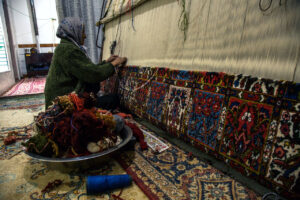
The width of the fabric is called a “Takhteh” (literally meaning a board). Simple materials, striped fabrics, animal covers, and even quality rugs with knotwork can be woven on this type of machine. I have never seen women work with the devices used for weaving large knot rugs, called “Ghali” (Carpet), but I have observed how these machines are set up several times.
For this work, they use thick sticks or even thin branches of trees. They set them up in a way that forms a vertical frame. Their height is about a man’s height, or maybe taller, and they draw threads vertically on them.
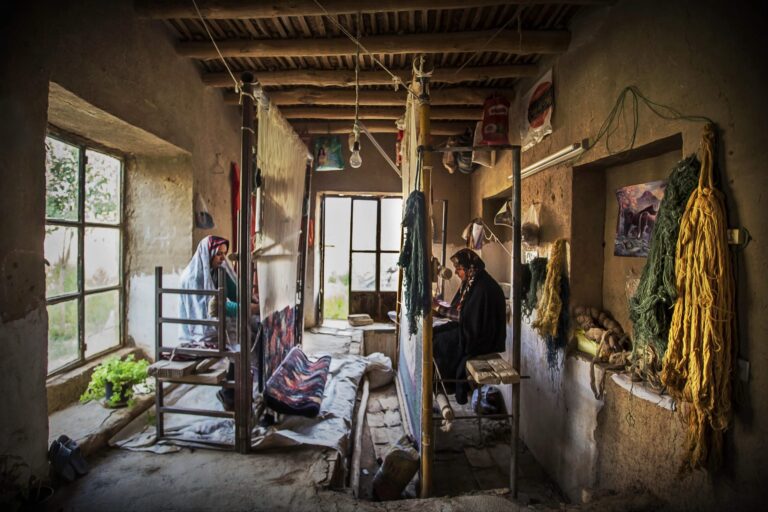
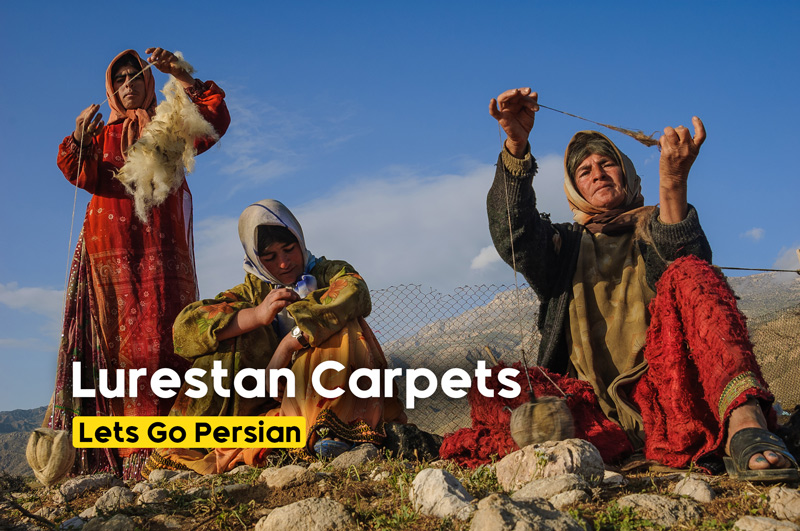
In early spring, I saw wooden sticks used in weaving machines, and they explained to me that at this time of year, women are still busy with wool spinning and begin weaving later, around the end of summer.
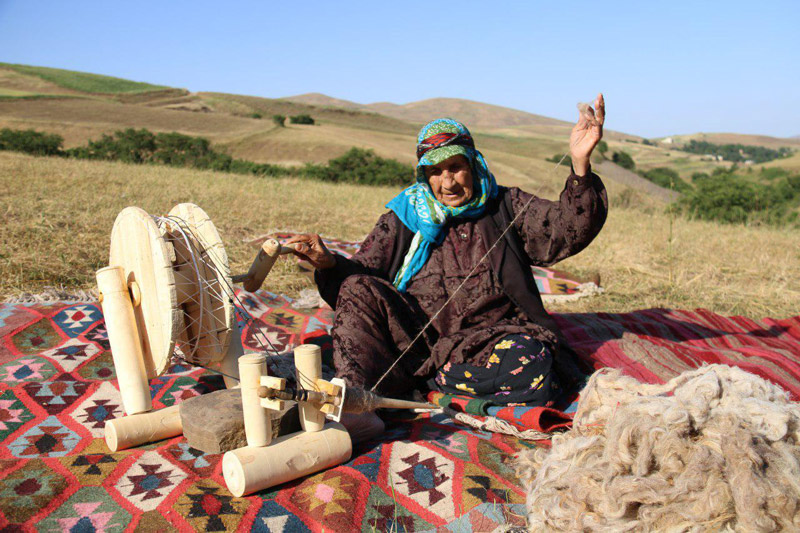
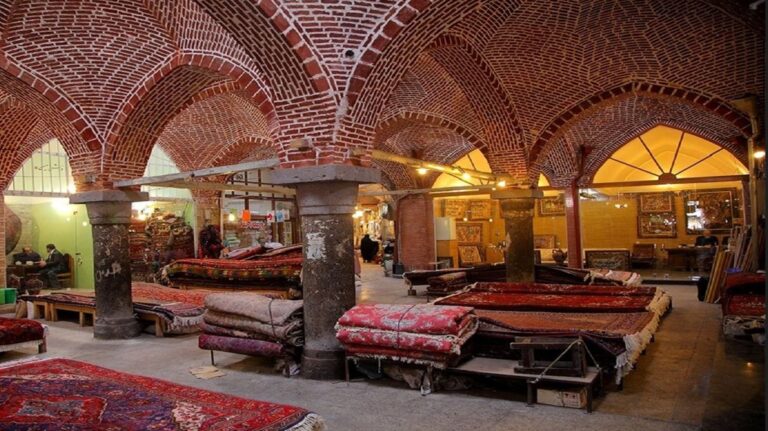
At this time, in most places, women are busy dyeing threads, and woolen threads are soaked in anticipation of dyeing in wooden trays or large metal trays. The Pappehs have a relationship with the city of Dezful in the winter and engage in trade with Khorramabad in the summer. In the summer, Khorramabad hosts many travelers and outsiders. On the other hand, the Lurs establish an economic relationship with the outside world without leaving their work and life. This means they sometimes sell woven items, such as carpets or jams, to traveling salesmen.”
Characteristics of Luristan Carpets
In Luristan, all locally woven carpets, whether in rural or nomadic areas, are known as “Lori” carpets. These carpets have the following characteristics:
Raw Materials
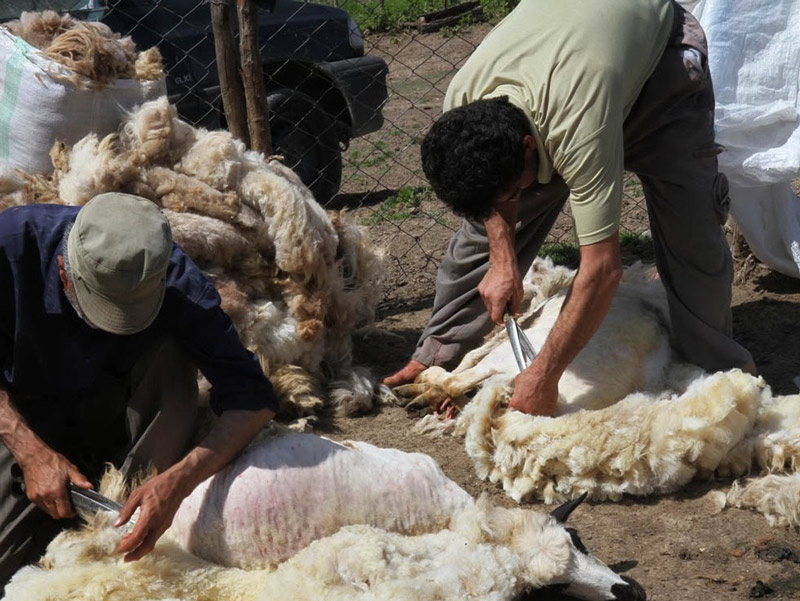
In the past, all the raw materials for handwoven textiles were produced in the region. Before the introduction of cotton and acrylic into the lives of nomads and villagers, women would separate sheep’s wool according to its color, wash it, and then dye it using natural substances found in the local environment. Preparing raw materials is rare today, and the primary materials for carpet weaving are sourced from neighboring provinces.
Dimensions of Carpets
Local Luristan carpets are small in size, and carpet dimensions are typically woven with a width of 1 to 2 meters and a length of 4 to 10 meters in abundance in this region.
Design and Color
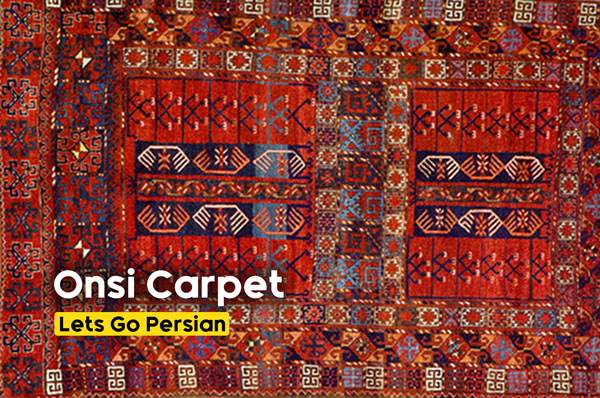
Traditional Luri designs are primarily geometric and abstract, and the number of borders varies between 2 to 5. The colors used for the background are typically red-brown (“laki”) and dark blue (“Sormei”). The number of colors used in Luristan carpets is limited, usually not exceeding six. The most commonly used colors for Luristan carpets are dark blue, red-brown, yellow, orange, blue, green, and pea-green. White is rarely used in these carpets.
Texture
The knot count in most Luristan carpets ranges from 15 to 25 raj (knots per square inch). The technique used for carpet weaving is “chelgeh keshi,” which is primarily symmetrical but can also be asymmetrical. The foundation of Luristan carpets is made from a combination of sheep and goat wool. The knots used in the rugs are either Persian or, occasionally, Turkish, depending on the weaving traditions.
Tools
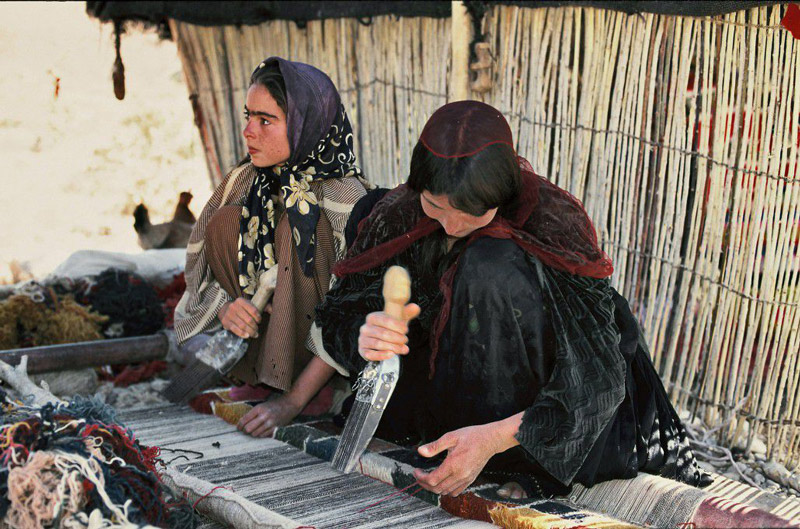
The tools used for Luristan carpet weaving include regular scissors, a knife, and a device known as “Karaza” or “karkit,” which has been introduced to the region in recent decades. In some areas, hooks have also been incorporated into the weaving process.
Dyeing
Traditionally, traditional dyeing used natural materials in the region, such as “Gandel,” “jaft,” grape leaves, runas and others. However, synthetic dyes are used in a few areas where local weavers still dye their yarn. Most of the thread needed for Luristan carpet weaving is generally sourced from local markets within the province and neighboring provinces.