Among the many elements that make Persian carpets uniquely beautiful, the design stands out as one of the most defining. While there are numerous patterns—such as Golestani, Mihrab, and Moharramat—the Lachak-Toranj pattern remains the most prevalent and recognizable in Persian handwoven carpets.
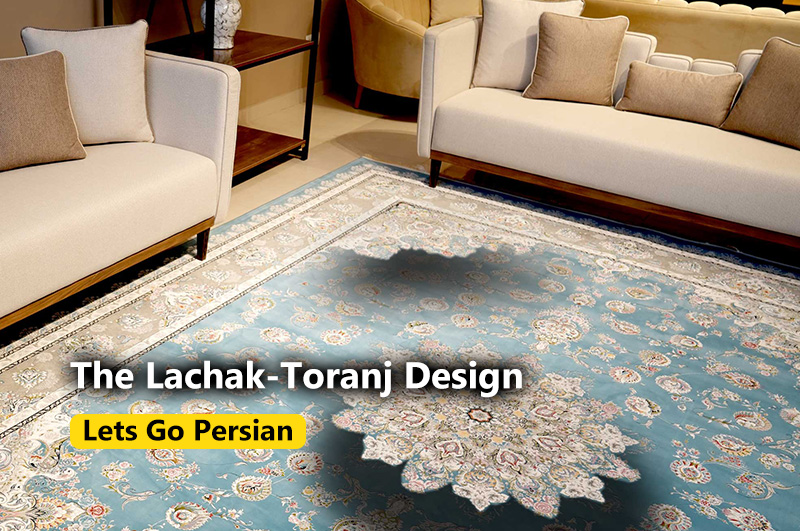
Often referred to as the quintessential Persian design, the Lachak-Toranj motif dates back to the 15th century, flourishing under the Timurid dynasty and later reaching its artistic peak during the Safavid era. Miniature paintings from those periods often depict royalty and noble figures seated upon carpets woven in this timeless pattern.
Origins of the Lachak-Toranj Motif
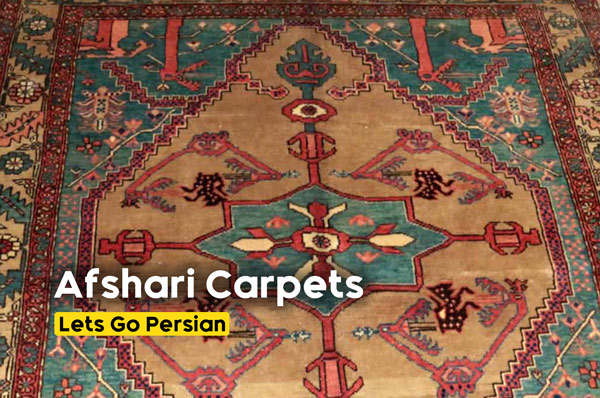
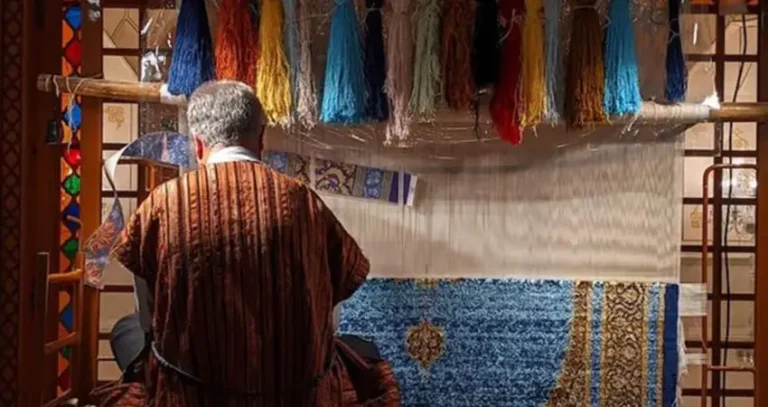
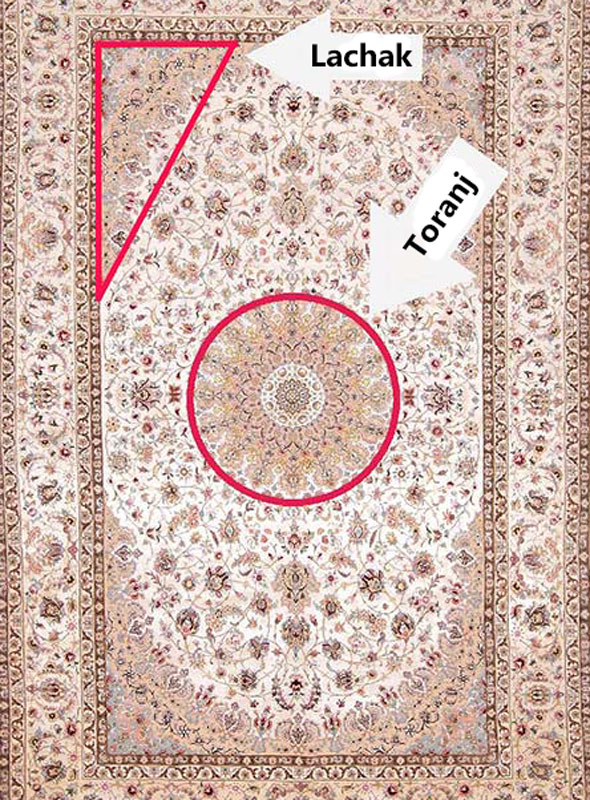
The inspiration for the Toranj (medallion) is thought to come from the layout of traditional Persian gardens. These gardens typically featured geometric pools (square, hexagonal, or diamond-shaped) connected by water channels. The central medallion in carpets reflects this concept, often taking an oval or circular form positioned along the vertical axis of the rug.
On the corners of the rug’s field, quarter medallions—known as Lachaks—mirror the central motif, giving the entire carpet a harmonious architectural balance. This four-part structure symbolizes unity and symmetry, core elements of Persian artistic expression.
Defining Lachak and Toranj
What is a Toranj?
The word Toranj (ترنج) originally referred to the citrus fruit “balang” (a type of citron), but in carpet design, it represents a central medallion that often resembles the sun—symbolizing life and divine power.
Toranj motifs are typically filled with floral and arabesque patterns and stand out through contrasting colors compared to the carpet’s background.
A complete Toranj includes:
Main body: The central medallion.
Sar-Toranj: The “head” of the medallion at the top and bottom.
Neck of the medallion: A transitional segment sometimes decorated with floral or circular elements.
These sections may also carry symbolic names such as kolaleh or kashkool, especially when crafted in the shape of sacred flowers like the Shah Abbasi blossom.
What is a Lachak?
Lachak (لچک) literally means corner, and in carpet design, it refers to the quarter medallions woven into each corner of the rug. These triangular patterns may reflect the design of the main Toranj or include related, harmonious motifs.
There is no fixed size ratio between the central Toranj and the Lachaks. In some carpets, the Lachaks are larger, smaller, or more elongated. Sometimes they blend into the background pattern; other times, they stand independently, depending on the artistic intent.
Artistic Variations and Symbolism
No two Lachak-Toranj carpets are exactly alike. Even if the structure remains similar, the motifs, color palette, and proportions can vary widely. One of the most beloved variations is the flower-filled Toranj, which is said to symbolize the sacred lotus flower. In this design, a cluster of small flowers is used to form the medallion.
The surrounding field often includes floral vines, tree-of-life elements, or grapevine scrolls, making these carpets rich in both detail and symbolism.
Famous Lachak-Toranj Carpets
Perhaps the most renowned example of the Lachak-Toranj design is the Ardabil Carpet, also known as the Sheikh Safi Carpet. Woven in the 16th century and now housed in the Victoria and Albert Museum in London, this masterpiece is considered one of the finest Persian carpets ever made and a true icon of Persian artistry.

Final Thoughts
The Lachak-Toranj motif isn’t just a design—it’s a visual storytelling tradition passed down for generations. Whether you’re an art enthusiast, a collector, or someone seeking a meaningful home décor piece, choosing a handwoven carpet with this pattern connects you to centuries of Persian culture and heritage.